
ChoiceMMed Fingertip Pulse Oximeter MD300 C63 - Adult and Paediatric
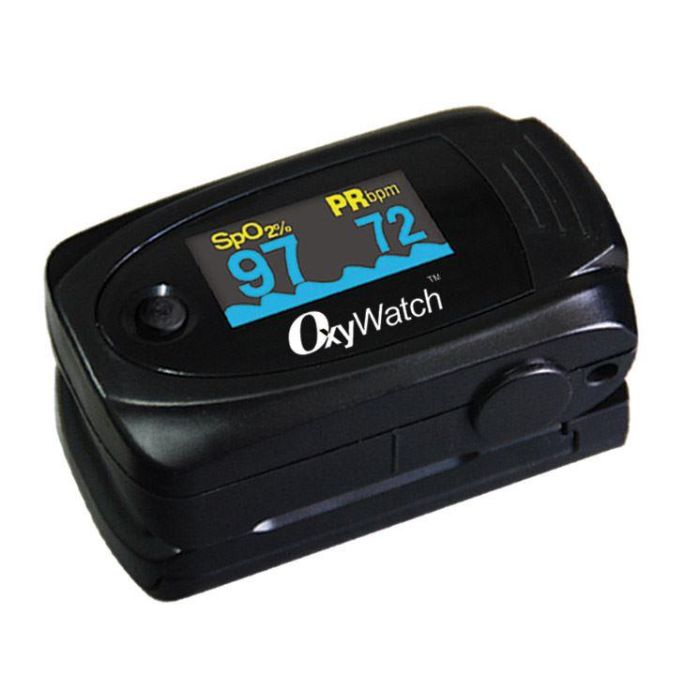
The ChoiceMMed MD300-C63 Oxywatch Finger Pulse Oximeter is a light & compact pulse oximeter with dual-colour OLED display
It is suitable for use on adults as well as paediatrics in a variety of applications like GP surgeries, Clinics, Dental surgeries, Ambulances, Hospitals, Home care through to spot-checking before, during and after exercise.
The Pulse Oximeter screen displays Oxygen saturation (SPO2), pulse rate, plethysmogram and pulse indicator bar graph. The bright organic LED display in dual colours with adjustable brightness and display modes offer superb visibility in all lighting conditions, including direct sunlight.
Features:
Clear, bright colour Organic LED display in two colours.
Displays SPO2, pulse rate, plethysmogram, pulse indicator bar graph
Display can be viewed in 4 rotations making it easier to read
Plethysmogram waveform, displayed in 2 formats
Adjustable brightness: 10 levels
Signal strength indicator
Easy to use; 1-button operation
Automatic power-off when finger removed
Special battery cover design to make it durable and robust
Suitable for paediatric and adult patients
Includes:
1x MD300-C63 Finger Pulse Oximeter
1x Lanyard
2x AAA Batteries
1x Instruction Manual
Battery Life:
Approximately 30 hours of continuous operation. Automatically powers off when finger is removed for longer than 8 seconds.
In stock
- SKU
- CHO-MD300C63
Description / ChoiceMMed Fingertip Pulse Oximeter MD300 C63 - Adult and Paediatric
The ChoiceMMed MD300-C63 Oxywatch Finger Pulse Oximeter is a light & compact pulse oximeter with dual-colour OLED display
It is suitable for use on adults as well as paediatrics in a variety of applications like GP surgeries, Clinics, Dental surgeries, Ambulances, Hospitals, Home care through to spot-checking before, during and after exercise.
The Pulse Oximeter screen displays Oxygen saturation (SPO2), pulse rate, plethysmogram and pulse indicator bar graph. The bright organic LED display in dual colours with adjustable brightness and display modes offer superb visibility in all lighting conditions, including direct sunlight.
Features:
Clear, bright colour Organic LED display in two colours.
Displays SPO2, pulse rate, plethysmogram, pulse indicator bar graph
Display can be viewed in 4 rotations making it easier to read
Plethysmogram waveform, displayed in 2 formats
Adjustable brightness: 10 levels
Signal strength indicator
Easy to use; 1-button operation
Automatic power-off when finger removed
Special battery cover design to make it durable and robust
Suitable for paediatric and adult patients
Includes:
1x MD300-C63 Finger Pulse Oximeter
1x Lanyard
2x AAA Batteries
1x Instruction Manual
Battery Life:
Approximately 30 hours of continuous operation. Automatically powers off when finger is removed for longer than 8 seconds.
More Information
| EAN | 609224162107 |
|---|---|
| Weight | 115.000000 |
| Manufacturer | ChoiceMMed |
| Is Featured | No |
Customer Reviews
see linked research paper:
Blood Press Monit. 2008 Dec;13(6):339-41.
Validation of A&D UA-85X device for blood pressure measurement.
Bonso E, Ragazzo F, Palatini P.
Department of Clinical and Experimental Medicine, University of Padova, Padua, Italy.
Abstract
To determine the accuracy of the UA-85X (UA-851, 852, 853, 854, and 855) device developed by the A&D company. Device evaluations were performed using the protocol of the European Society of Hypertension (ESH). Monitor performance was assessed in relation to patients' age, arm circumference, and systolic and diastolic blood pressures (BPs). The device was assessed in two different samples according to ESH requirements, which are based on four zones of accuracy differing from the mercury standard by 5, 10, 15 mmHg, or more. The UA-85X passed all three phases of the protocol for systolic BP and diastolic BP. Mean BP difference between device and observers was -0.3+/-4.4 mmHg for systolic BP and -2.7+/-4.8 mmHg for diastolic BP. These passed the Association for the Advancement of Medical Instrumentation standard requirements. In multivariable analyses, systolic BP discrepancies between device and observers were related to age (P=0.03) and diastolic BP discrepancies were related to diastolic BP level (P